 Physical Review A 114, 053720 (2026), published 18 November 2026
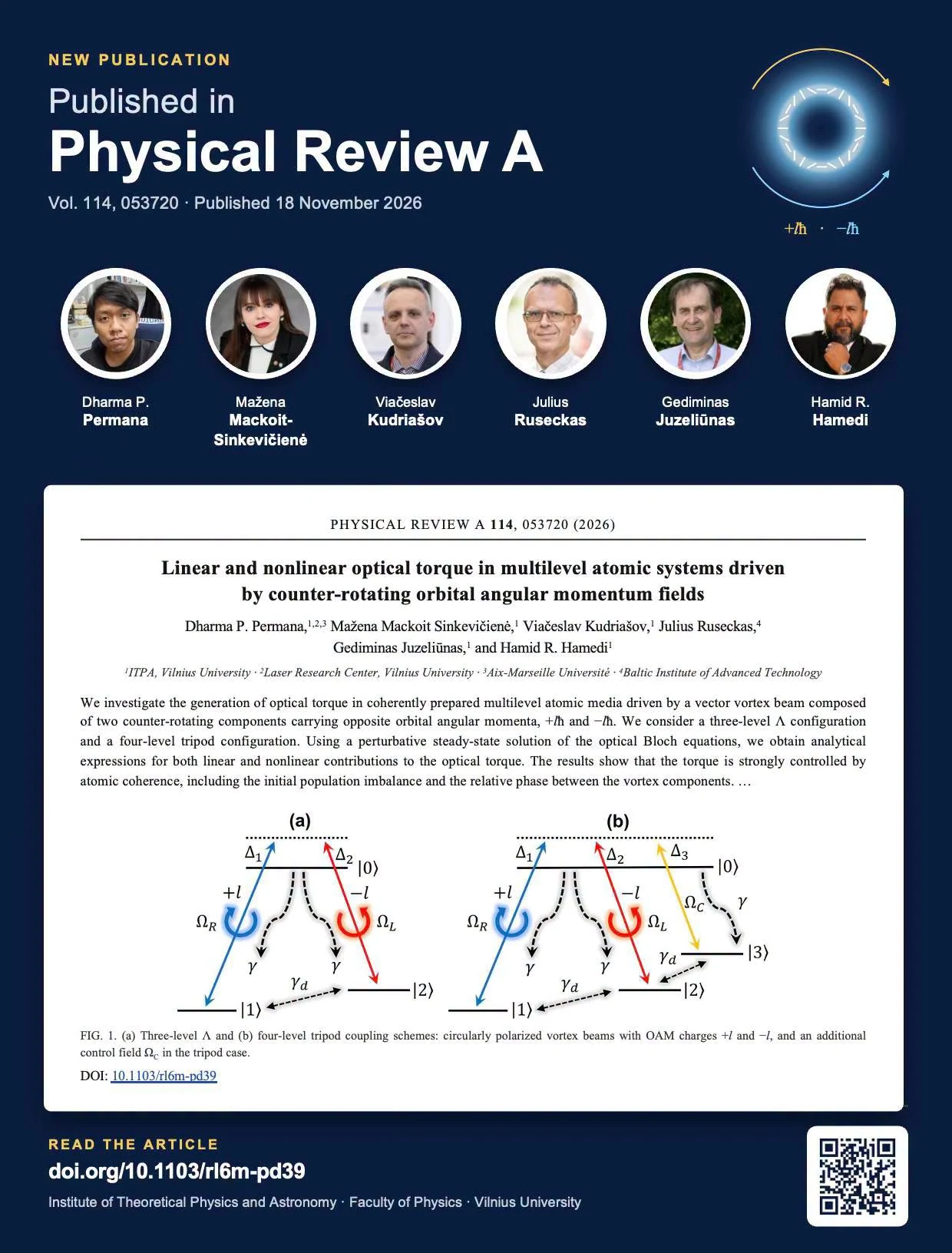
Light carries energy, but it can also carry rotation. In so-called vortex beams the wavefront spirals like a corkscrew, and each photon carries orbital angular momentum, +lħ or −lħ. When matter absorbs such light, it can feel a tiny twist: an optical torque.
Our new paper, just published in Physical Review A, asks what happens when atoms are hit by two vortex components twisted in opposite directions at the same time. You might expect the two twists to simply cancel out. They don't have to! We show that the net torque is controlled by the atoms' own quantum state, their coherence. By tuning the initial population imbalance or the relative phase between the two light components, we can change the strength and even the direction of the twist, even when both components are equally strong.
We studied two classic atomic configurations: a three-level Λ scheme and a four-level tripod scheme. In the tripod, a strong control laser makes the atoms transparent (electromagnetically induced transparency). This suppresses the torque near resonance and moves it to slightly detuned frequencies. From the optical Bloch equations we derived analytical expressions for both the linear and the nonlinear contributions to the torque.
Why it matters: structured light becomes a new knob for controlling rotation in atomic media, with potential uses in coherent optical manipulation and quantum technologies.
Huge thanks to a wonderful team: Dharma P. Permana, Viačeslav Kudriašov, Julius Ruseckas, Gediminas Juzeliūnas and Hamid R. Hamedi!
Read the paper on the journal's website: D. P. Permana et al., "Linear and nonlinear optical torque in multilevel atomic systems driven by counter-rotating orbital angular momentum fields", Phys. Rev. A 114, 053720 (2026). Physical Review A is one of the American Physical Society's leading journals in atomic, molecular and optical physics.