On 18 November I was invited to take part in the event “Physicists and Lyricists” (“Fizikai lyrikai”) at Mykolas Biržiška Gymnasium in Vilnius and to share my poetry. This is the school that more of our physicists at the Vilnius University Faculty of Physics come from than any other!
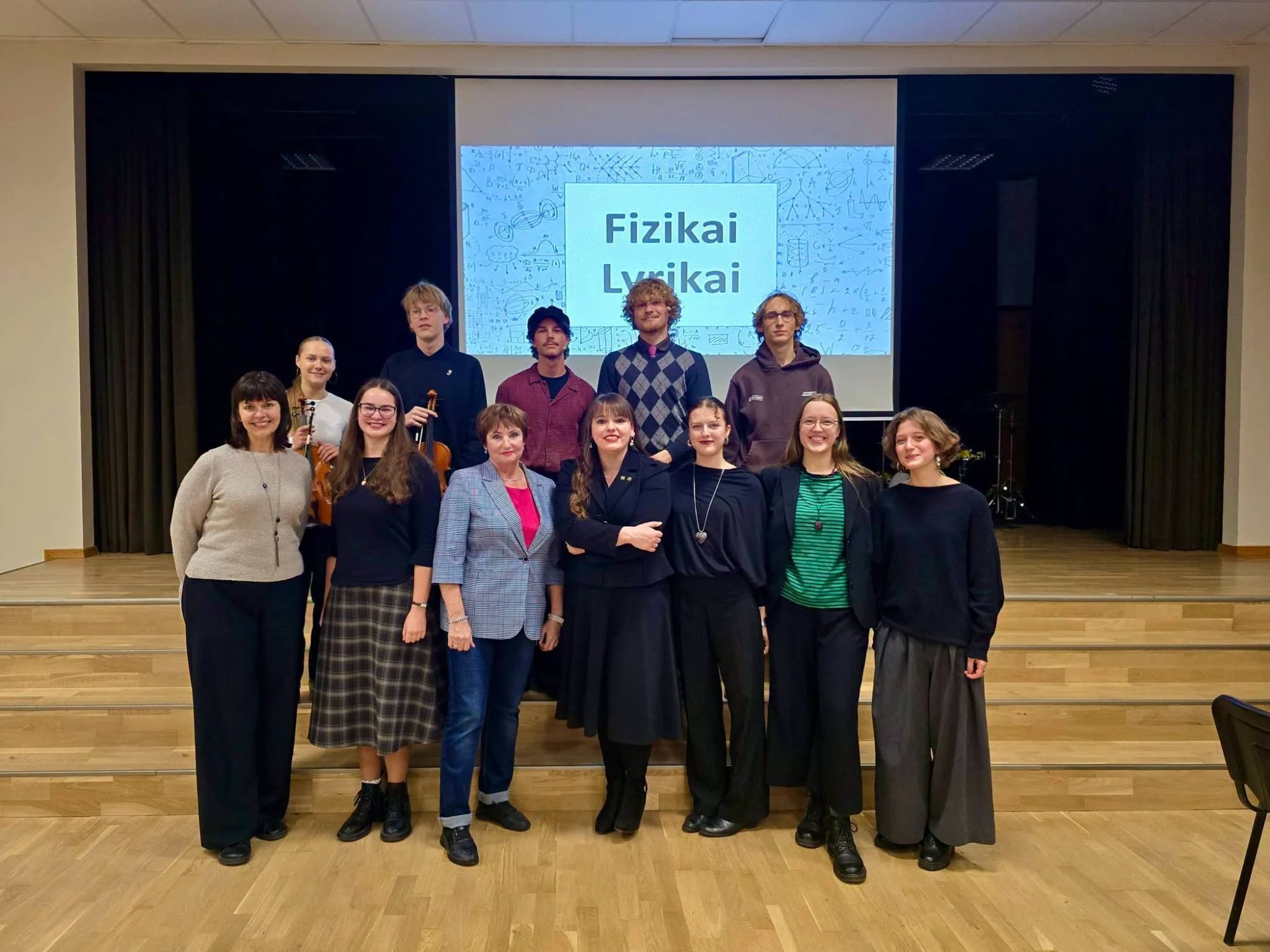 Participants of the “Physicists and Lyricists” event
Back in 1920, Niels Bohr told the young Werner Heisenberg that when it comes to atoms, language can be used only as in poetry. You cannot see the world of atoms with your own eyes, so we talk about it in images and metaphors – just like poets. So the pupils and I played a game: I read a poem, and then together we looked for the physics hidden in it – from the Moon, which always shows us the same side, to Schrödinger's cat, quantum entanglement and the defects in crystals that I study, which emit single photons.
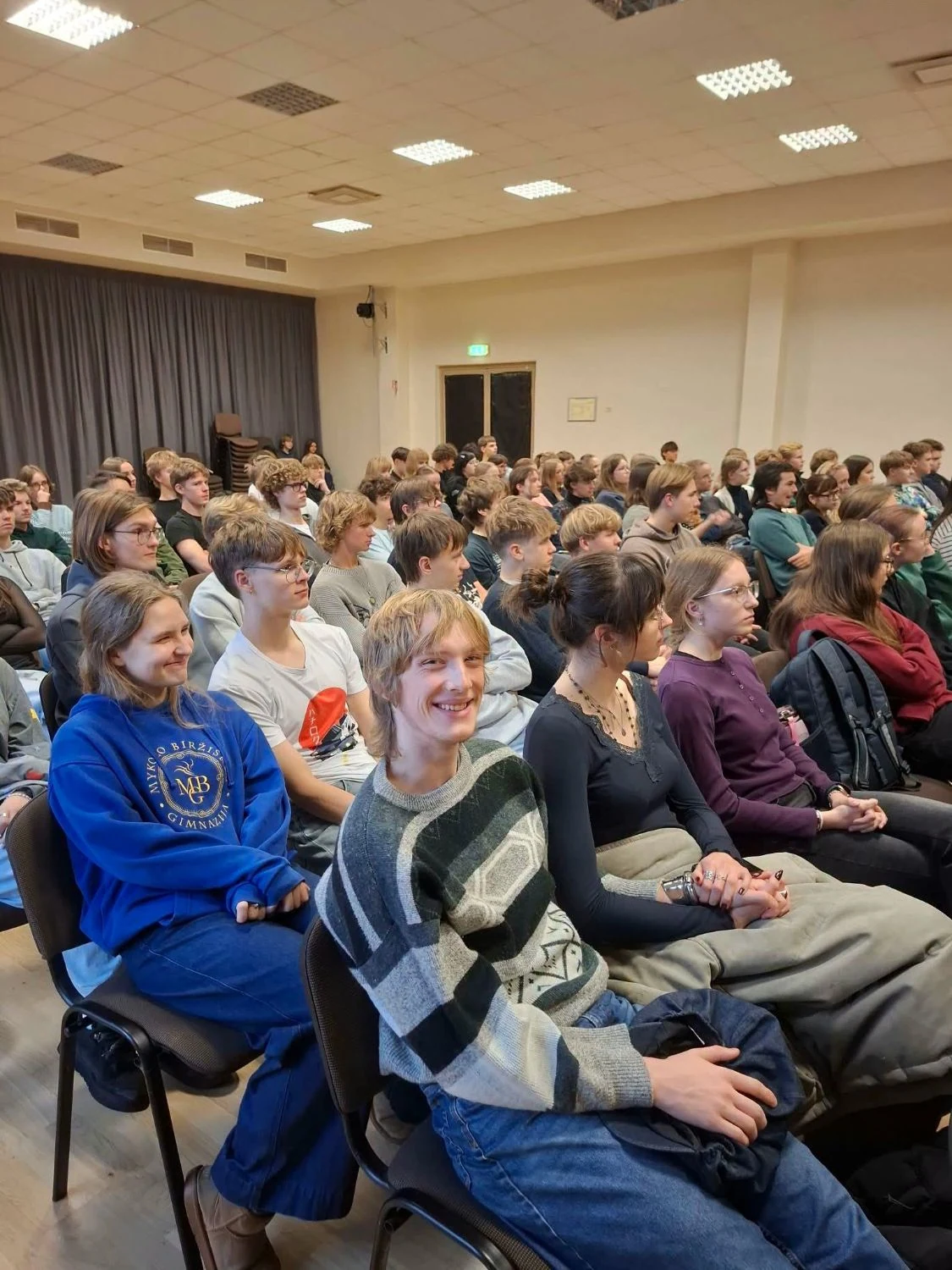 Attentive and curious listeners
Here is one of the poems I read – the one closest to my work, since I work with optical atomic clocks. (Translated from Lithuanian.)
Atomic Clock
Three times I struck my chest with my fist,
hugged the cat, kissed the walls of my home.
I breathed in until it hurt.
The atomic clock struck twelve,
so I set off into space,
into stardust,
cutting my feet,
worn out from wandering.
On a spellbinding cosmic odyssey
I saw nothing.
No neutron fountain, no life on Mars,
only the white moon
blushing with shame.
Tonight it is blood red.
Then, like a child, I took a spoon
and drank up the dark, boundless abyss.
The atomic clock stopped working.
Where is the physics? The Moon turns blood red during a total eclipse: the only light reaching it then has passed through Earth's atmosphere, which scatters blue light and lets red through – that night, all of Earth's sunsets are, in a way, reflected on the Moon. And the dark, boundless abyss where the clock stops is a black hole: seen from far away, a clock falling into one ticks slower and slower until, at the event horizon, it seems to stop.
At the end I gave the pupils a task: pick one physics word – entropy, orbit, resonance, superposition – and write three lines about it. No need to be afraid of mistakes – after all, defects in crystals glow too. Bohr said that atoms can only be spoken about as in poetry. That means every poet is already a bit of a physicist, and every physicist a bit of a poet.
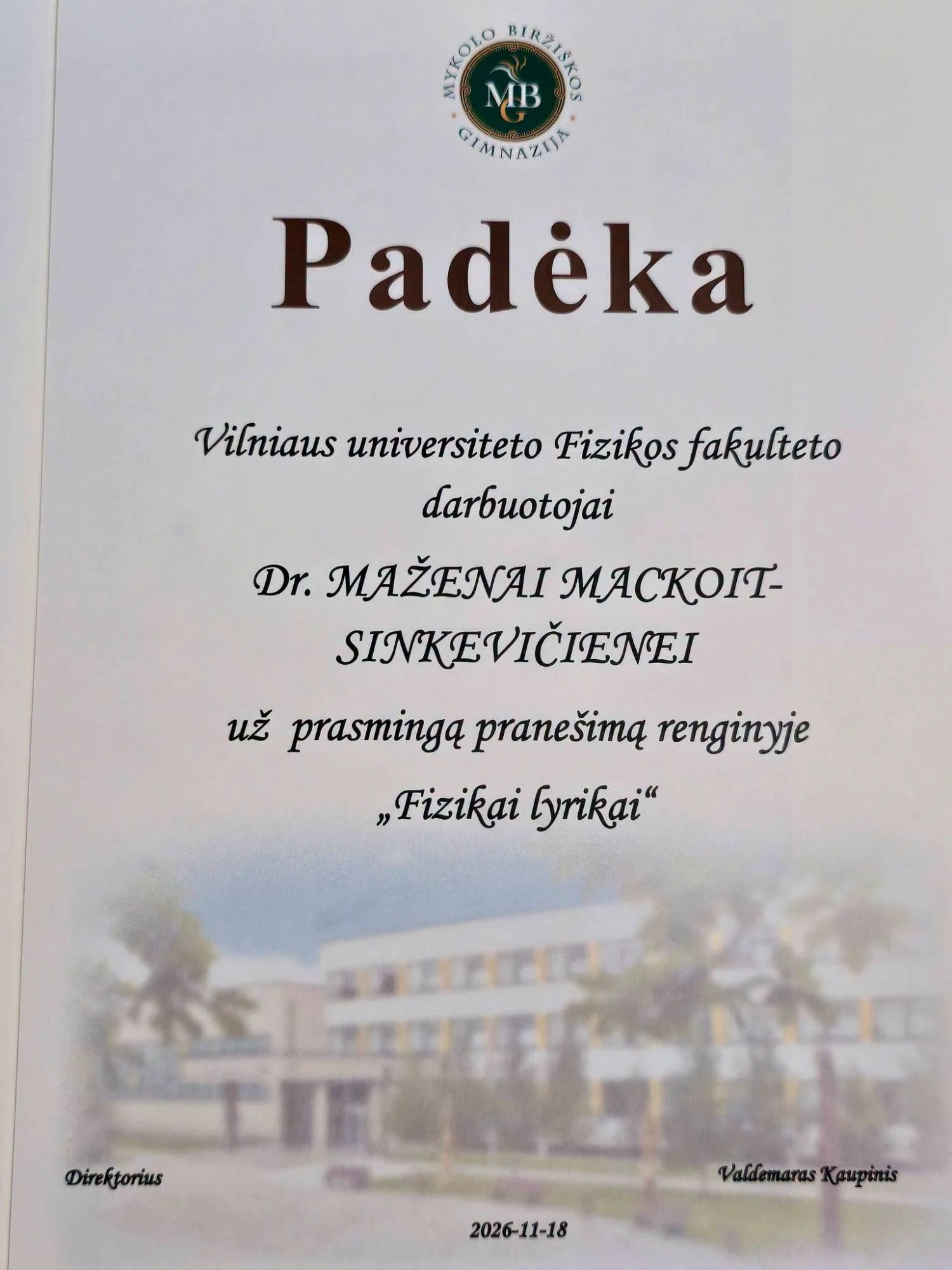 Certificate of thanks from Mykolas Biržiška Gymnasium
Warm thanks to R. Miliajeva for the invitation, and to the pupils and teachers for a lovely event where physics and poetry sounded together.